Friday, 25 April 2014

Thursday, 24 April 2014
Wednesday, 23 April 2014
Tuesday, 1 April 2014
Evaluation - Question Seven -Looking back at your preliminary task, what do you feel you have learnt in the progression from in to the finished product.
Looking back at your preliminary task, what do you feel you have learnt in the progression from in to the finished product.
Monday, 31 March 2014
Evaluation - Question Five - How did you attract/address your audience?
How did you attract/address your audience?
Throughout our media thriller opening we kept the audiences attenttion buy using some of the typical thriller conventions that typical thriller audiences would look for. For example, we used a MacGuffin and many other thriller conventions. A MacGuffin is seen as an object that is used by the characters as a mystery and all the people in the audience want to know about. We used the MacGuffin right at the beggining of our thriller opening by getting the two characters to talk about it, although they do not tell the audeince exactly what they are talking about. This helps the audience to get an insit into what the MacGuffin could be and to introduce the characters to the audience.
Also the use of the point of view shot from the kidnappers allows the audience to captivate what is actually going on and to get into the shoes of the kidnapper(s).
After watching our thriller opening and only seeing the boys talk about something mysterious happening and seeing/watching the boys get kidnapped the audience are goinng to want to see more which will the keep the audience hooked. Finally there is a close up of the MacGuffin, this being the disc and the audeince then get a little insite in to what is goin gon however, it does not give too much away and leaves room for interpretation on the views behalf. This then keeps the audience intouch with the characters and keeps the suspense going.
Monday, 17 March 2014
Evaluation Question Two - How does your media product present particular social groups?
QUESTION 2: How does your media product present particular social groups?
Within our group thriller opening, there are only four characters. However, all four characters are boys, this leaves us very little option as to stereotype some but not all of the boys. For example, we have two villains. They're both wearing masks to cover there faces. We chose to do this to convey how powerful the two masked men are, as they have all the power as they are unknown therefore feared. However, the two other characters are unmasked and known to everyone. As we chose to only follow the stereotypical "powerful man" for just the two villians we therfore chose to portray the other two boys as more weak and dominated by the two kidnappers. This challenges hegemony as the characters do not conform to the typical stereotype of men being dominant as they got kidnapped by men themselves.
Our thriller opening consists of typical blue collar crime, as the villians are getting their hands dirty instead of commiting crimes that tend to include sitting behind a computer screen for crimes such as fraud, those types of crimes are known as white collar crimes and they are usually comminted from people from the upperclass who have more sophisticated jobs as they are then able to commit more dangerous crimes. However as our thriller opening includes young teenage boys and kidnapping being the main crime being committed we chose to portray the boys as typical working class teenages who have nothing better to do than get involved with crime and seek a thrill for it.
Although our main characters are teenage boys they do not typically conform to the stereotypical 'trouble maker' throughtout the whole of the opening, however the kidnappers may conform as they are the ones committing the crime which is typical of their age group and social class.
Although our main characters are teenage boys they do not typically conform to the stereotypical 'trouble maker' throughtout the whole of the opening, however the kidnappers may conform as they are the ones committing the crime which is typical of their age group and social class.
Evaluation Question One - In what way does your media product use, develop or challenge forms and conventions of real media productions?
QUESTION ONE: In what way does your media product use, develop or challenge forms and conventions of real media productions?
There are many conventions that are used within a real media production. These can include things such as a MacGuffin, Suspense, a twist, fast pacing, slow pacing, Fem Fatale, Red Herring, Cliff hangers etc.
Throughout the making of our film we came up with many ideas to use different types of conventions in our film however felt that using a Cliff Hanger, a MacGuffin and suspense would benefit us most with the type of film we chose. We also chose to include other typical thriller conventions such as a point of view shot(POV), close up shots(CU) and high angle shots(HA).
MacGuffin:
A MacGuffin is usaually an object that the Antagonist wish to obtain. The MacGuffin in our opening film is a CD named "File 45-7". We chose to use a MacGuffin for many reasons when making our film. One of the reasons being that it would interlink with the name of our film, this showing continuity throughout the making of our film and secondly we needed an object that the antagonist (kidnappers) would go after & cause chaos. The use of the MacGuffin helped support the idea of our film being a archetypal thriller.
Suspence:
Suspense it typically known to be a key convention within the thriller genre and real media productions. When talking about suspense i refer to the idea of the build up of an atmosphere in a film that normally leaves viewers wanting to know more and clinging to the edge of their seats. Throughout our film there is a large build up of suspense. For example, when the two boys are walking into the park and arguing there is a point of view shot which creates suspense as the viewers are then able to get into the role of the kidnapper. Another example of suspense in our film would be when one of the boys gets kidnapped as the suspense and tensions builds up quickly and is very mysterious and the viewers are very keen to find out what is going on and who is behind the mask.
Cliff Hanger:
A cliff hanger is a dramatic or exciting ending to a scene of piece of filming leaving the audience/viewer in suspense and creating tension to make the viewer want to see more. Cliff hangers are usually used at the end of scene in a film as they are more effective towards the audience/viewer. In our thriller there are many cliff hangers, we chose to do this as we feel that it will have a big effect on our audience as they are going to have loads of questions about what is going to happen to the characters in the scene. However the kidnapping scene in our film would have to be the biggest cliff hanger as it for one is right in the middle of our opening and secondly is where the main storyline lies.
Thursday, 13 February 2014
Speed of editing
Editing is when you look at all the footage you have when making a film or a tv programme etc. There are 2 key areas we studied when looking at editing. The first was the speed of editing, the speed of editing depends on how long the scene itself is. A scene in a film can last either seconds or minutes, depending on how long the scene is depends on how fast pace the film will be and this helps the audience understand the mood of the scene or the film as a whole.
Fast pace editing is normally used to to show action in a scene to helps create suspense or tension in a scene. However, slow pace editing is used when the director is creating a calm and relaxed scene for the audience to enjoy. This is typically used at the beginning of a film to help introduce a character and start the atmopsphere off
Fast pace editing is normally used to to show action in a scene to helps create suspense or tension in a scene. However, slow pace editing is used when the director is creating a calm and relaxed scene for the audience to enjoy. This is typically used at the beginning of a film to help introduce a character and start the atmopsphere off
Editing styles
Editing
styles refer to how the scenes are put together. These are done through things
called transitions, this meaning the movement from one shot to another. There
are many types of transitions and some are listed below:
- Dissolve- this is when one shot fades out and another fades in. In the middle of the dissolve, when the shot is fading out and the other just beginning to come in you can sometimes see a relationship between the two shots. This is done intentionally.
- Straight cut- This is the most commonly used style of editing. This is the simple move between shots that isn't normally seen but helps keep the scene look real and relatable.
- Fades- this is when the shot fades to either black or white. They are typically used at the end of a scene or film.
- Wipe- this is when one shot is pushed out the scene by another shot. This normally occurs to signal a similar situation that is happening elsewhere.
- Jump cut- This is when the camera jumps from one shot to another whilst the scene is still occurring.
Editing our thriller opening

whilst i was currently blogging about the process of our group thriller a member of our group was able to begin editing
the few clips that we filmed for our thriller in order to get an idea of how the film is going
to look.
It was all very new to us as we were using software that we have no previous knowledge of and it was a great experience.
It was all very new to us as we were using software that we have no previous knowledge of and it was a great experience.
Tuesday, 11 February 2014
Recipe for a Thriller
Characterisation of a Thriller;
Thrillers are characterised by fast pacing, frequent action and resourceful heroes who must destroy the plans of more powerful more equipted villians.
Thrillers often take place in excotic locations typically set in foreign cities.
Thriller devices;
Devices such as suspence, red herrings and cliffhangers are used lots in a tyoicl thriller movie. A typical Thriller consists of a villian with a plot to kill or over take someone or something and making it nearly impossible for the hero to 'save the day'.
A flexible thriller;
The thriller is a flexible genre that can engage the audience throught a dramtic use of psychological, social and political tention. Alfred Hitchcock describes thrillers as allowing the audience "to put their toe in the cold water of fear to see what it is like"
Mystery stories;
Thrillers often overlap with mysterious stories, but are hidden by the structure of the plot.
Definitions of Thrillers;
Thrillers provide such a rich literary feast. The legal thriller, spy thriller, ation-adventure thriller, medical thriller, police thriller, romantic thriller, historical thriller, political thriller, religious thriller, high-tec thriller, military thriller. In fact, this openness is on of the genre's most enduring cahracteristics.
Sub genres;
There are many thriller genres and these can include:
Thrillers are characterised by fast pacing, frequent action and resourceful heroes who must destroy the plans of more powerful more equipted villians.
Thrillers often take place in excotic locations typically set in foreign cities.
Thriller devices;
Devices such as suspence, red herrings and cliffhangers are used lots in a tyoicl thriller movie. A typical Thriller consists of a villian with a plot to kill or over take someone or something and making it nearly impossible for the hero to 'save the day'.
A flexible thriller;
The thriller is a flexible genre that can engage the audience throught a dramtic use of psychological, social and political tention. Alfred Hitchcock describes thrillers as allowing the audience "to put their toe in the cold water of fear to see what it is like"
Mystery stories;
Thrillers often overlap with mysterious stories, but are hidden by the structure of the plot.
Definitions of Thrillers;
Thrillers provide such a rich literary feast. The legal thriller, spy thriller, ation-adventure thriller, medical thriller, police thriller, romantic thriller, historical thriller, political thriller, religious thriller, high-tec thriller, military thriller. In fact, this openness is on of the genre's most enduring cahracteristics.
Sub genres;
There are many thriller genres and these can include:
- Action thriller
- Crime thriller
- Consiracy thriller
- Disaster thriller
- Drama thriller
- Erotic thriller
- Legal thriller
- Medical thriller
- Political thriller
- Spy thriller
- Psychological thriller
- Techno thriller
- Religious thriller
Our Group Ident
GROUP IDENT

So today we decided as a group to create our group ident. We used a few different adobe programmes such as,
Fireworks, Photoshop and Premier Pro. We did run into a few problems whilst we were
creating the ident as non of our group members had experienced or had any idea as to how we would use some of the programmes that we did. However, we had loads of questions about how to use the programmes and decided to search many of the questions we
had into Google and YouTube. We were then able to get a basic understanding
of how to use many of the programmes that we needed to and we were then able to create and finish our group ident.
Wednesday, 5 February 2014
Alfred Hitchcock
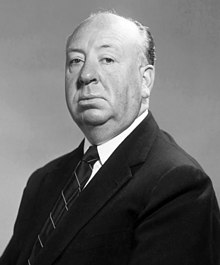
Sir Alfred Joseph Hitchcock was an English film producer and director. After a successful career in both silent films and early talkies, renowned as England's best director, Hitchcock then moved to Hollywood in 1939 and then became a U.S citizen in 1955.
Hitchcock was dubbed as 'the master of suspense thrillers' and is said to have directed fifty- three films in six decades. Out of all the the movies that he directed only one was 'lost' due to the celluloid which was his second film 'Mountain Eagle'.
Mise-En-Scene
Mise-en-scene
Mise-en-scene is a french word that refers to everything that is seen in the scene or frame. Mise-en-scene would include:

Mise-en-scene is a french word that refers to everything that is seen in the scene or frame. Mise-en-scene would include:
- Settings and Props
- Costume, hair and make-up
- Facial expressions or body language
- Lighting and colour
- Position/location within the frame
When filming a scene, every aspect is looked over carefully. For example in a thriller the audience is likely to see old, eerie settings, weapons, suits or spy clothing, well represented body language, low key lighting and bright explosions. Mise-en-scene has to been carefully constructed to fit its specific genre and narrative.
An example of how Mise-En-Sene taking place would be when watching a horror or a thriller, you would typically expect there to be blood and gore. You would also expect the 'bad guy' to be covered in blood or to wear specific dark clothes to portray his/her character.
An example of how Mise-En-Sene taking place would be when watching a horror or a thriller, you would typically expect there to be blood and gore. You would also expect the 'bad guy' to be covered in blood or to wear specific dark clothes to portray his/her character.
Sound
Within media productions there are multiply types of sound. These consisting of: ·
Diegetic sound- this is the sound that has not been edited into the film and would be found in the film.
Non- diegetic sound- this is the sound that has been added into the film and would not be typically found in a film.
On screen sound- this is the sound that is diagetic and fits to the action happening on screen.·
Off screen sound- this is the sound that again is diagetic but occurs out of the scene.·
Parallel sound- this is the sound that fits the action·
Contrapuntal sound- this is the sound that doesn't fit to the scene·
Sound bridge- a sound bridge is sound that carries on from one scene to another.The use of sound is very important in any media production and sometimes even the lack of sound is effective within a scene. Sound helps the producer to produce the feeling and emotions tat they want the audience to experience.
Thriller Genre Conventions
The thriller has multiple conventions that highlight the idea of the film being a thriller. For example there are typical characters, iconography, settings, themes etc. for example in more recent thrillers we have a typical strong, handsome and well groomed man that is usually the main character and seen as the protagonist and the typical setting for a thriller seems to be a deserted and isolated place.
Cinematography
Cinematography is the art of camera work and photography throughout a piece of media film. Cinematic style is referred to as the camera work and music that is commonly found within a particular genre. Audiences do not normally recognize cinematography however without cinematography conventions the audience wouldn't be able to recognize what genre the film would be categorized into.
Camera shots:
- Long shot (LS)
- Close up (CU)
- Medium Shot(MS)
- Extreme Close up(ECU)
- Low angle(LS)
- High angle(HA)
- Point of view(POV)
Narrative
Narrative
Narrative refers to the sequence of events. There are people that get ‘Narrative’ and ‘Story’ confused. Narrative is the way in which the story is represented to its audience. It doesn’t necessarily have to be in a specific continuous ordered for example in ‘Interview with a vampire’ the film starts off with the ending scene.
Subscribe to:
Posts (Atom)